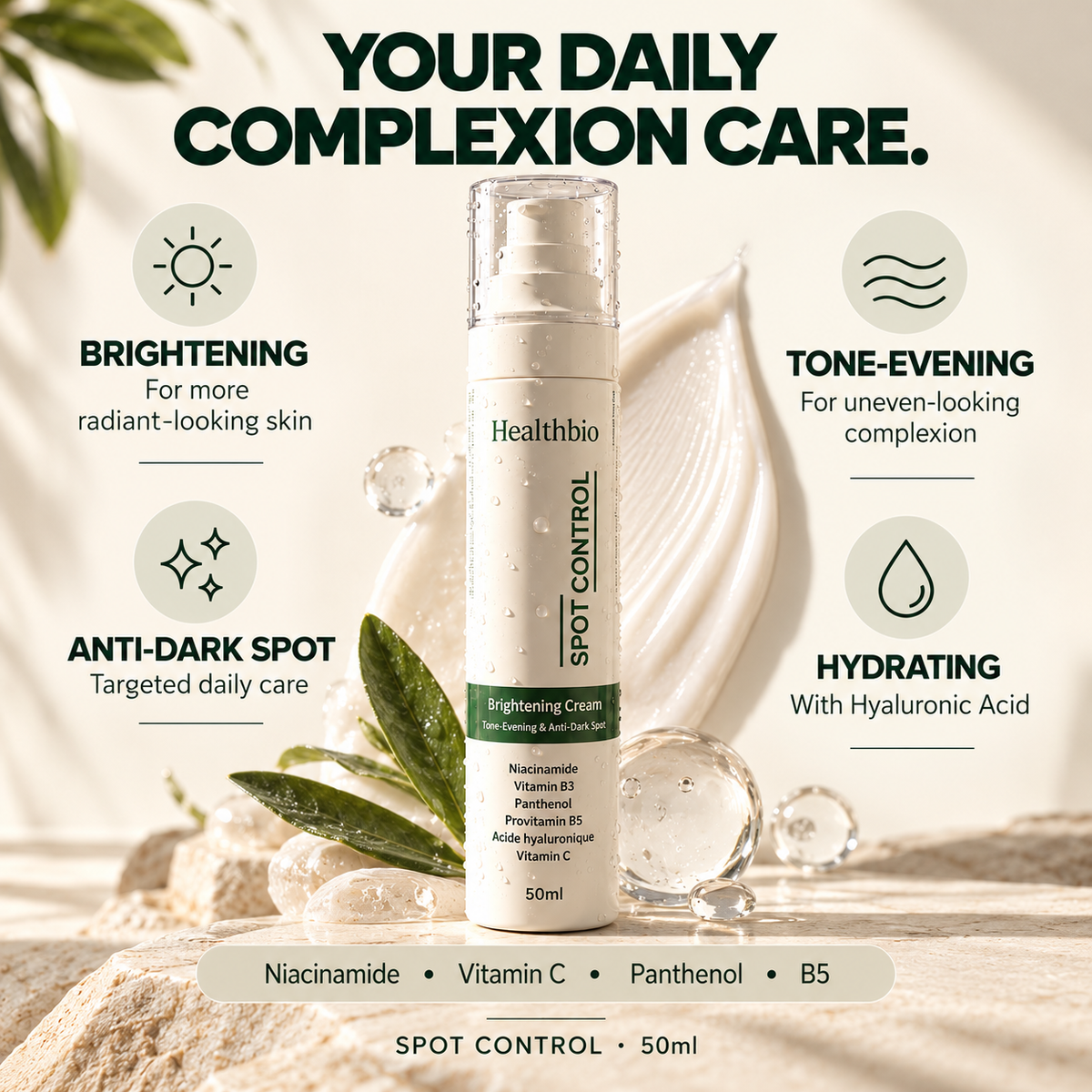
Daily care for the look of dark spots and uneven tone — built for the twelve weeks it actually takes, not the three weeks most people give it.
Take a photo in the same light on day one. If you can’t see a difference in the look of your tone by week twelve, tell us and we’ll refund it — bottles used.
“It stopped working after a month.”
It was working. The tap was still running.
Sun on unprotected skin. Or inflammation — a spot that healed, a shaving nick, a reaction. Both tell the skin to make pigment at that exact place.
It isn’t sitting on the surface where you could scrub it off. It has been delivered into the cells that make up your skin’s upper layers, and those take weeks to turn over.
A brightening formula works patiently on the look of what is already there. Slowly, because it has to wait for that turnover to happen.
One bright afternoon without protection and the trigger fires again. New pigment lands faster than old pigment leaves. So nothing appears to change.
Which is why the most important instruction on this page has nothing to do with this cream.
A brightening cream can work on the spots you have. It can’t out-run the ones you’re still making.
The whole argument, in one line
Of everything that makes marks darker and more stubborn, ultraviolet is the one you can actually control. UVA reaches your skin year-round, through cloud and through window glass, and it doesn’t need to burn you to deepen pigment that is already there.
Use a brightening cream without daily sun protection and you are working against yourself every afternoon. Use the two together and the cream finally gets to stay ahead.
Honestly: if you only buy one of the two, buy the sunscreen.
Before a fair verdict. Pigment sits in cells that take weeks to turn over — most people quit at three and conclude it doesn’t work.
And only two of them are a sensible job for a cosmetic cream. We’ll tell you which one isn’t, further down this page.
Hydroquinone, bleaching agents, or acids strong enough to irritate your skin into making a fresh mark.
They look alike in a mirror and behave completely differently. Working out which one you have is the difference between twelve patient weeks and twelve wasted ones.
Flat, brown, freckle-like. Cheekbones, forehead, backs of hands. Years of accumulated sun. Slowest to shift in appearance — and the most responsive to daily SPF.
The brown shadow a healed breakout leaves behind. These do settle on their own over months — a brightening routine and strict SPF stop them deepening while they do.
Larger, cloudier patches, often fairly symmetrical across cheeks, forehead or upper lip. Usually hormonal. This one needs a dermatologist — a cosmetic cream is the wrong tool, and we’d rather say so.
Irritation is itself a trigger for pigment. Which means an aggressive brightening product can leave you with a fresh mark where the old one was — and is exactly why this one isn’t built that way.

The most-studied ingredient there is for the appearance of uneven tone. It works on the handover of pigment to surface cells rather than trying to bleach anything — which is why it’s gentle enough for daily use.

Works on radiance and the look of brightness overall, and mops up some of the oxidative damage daylight causes. It partners with sunscreen rather than replacing it.

Despite the name, nothing to do with exfoliating acids. It holds water in the upper layers — and well-hydrated skin reflects light far more evenly, which is a real part of why tone looks more uniform.

The one doing defensive work. It soothes and supports the barrier, so twelve weeks of daily use doesn’t end in the irritation that starts the whole pigment cycle over again.
A twelve-week product bought for the wrong reason is twelve weeks of disappointment. Here’s the honest sort.

A pea-sized amount on clean skin, dotted over the areas you care about. Morning and evening, every day — consistency beats quantity here by a distance.

Smooth it over the whole face, not just the marks. Tone evens out as a whole — spot-treating tends to leave lighter patches rather than even skin.

Every morning, without exception. This is the step that decides whether the other two were worth doing.
Same spot, same light, no makeup. Changes this gradual are invisible in a mirror you look at every morning — a photo from twelve weeks ago is the only honest way to judge it, and most people are genuinely surprised.
Skin feels softer and looks a little plumper. That’s the hyaluronic acid, and it is not the thing you bought this for. No tone change yet — there can’t be.
Still nothing obvious. This is where most people decide it doesn’t work and stop. The cells carrying the pigment simply haven’t turned over yet.
The usual first real sign isn’t individual spots — it’s the skin around them looking more even, so the marks stand out less against it.
Where a fair judgement becomes possible. If you’ve worn SPF every day and used it twice daily, this is where the day-one photo earns its keep.
Individual experience varies. Spot Control is a cosmetic product for the look of dark spots and uneven tone — it is not a treatment for any skin condition.
Four routes people take with dark marks. The strongest option on this table is not ours, and pretending otherwise would be insulting.
| Spot Control daily cream |
Vitamin C serum alone |
At-home acid exfoliant |
Prescription from a doctor |
|
|---|---|---|---|---|
| Strength of effect on stubborn marks | Gradual | Mild | Moderate | Strongest |
| Safe to use twice a day, long term | Yes | Usually | No | Supervised only |
| Risk of irritation causing a new mark | Low | Low–moderate | Real | Doctor-managed |
| Also hydrates and supports the barrier | Yes | Rarely | No | No |
| Appropriate for melasma | No | No | No | Yes |
| Available without an appointment | Yes | Yes | Yes | No |
If your marks are deep, long-standing or spreading, a dermatologist will get you further than any cream sold online. We’d rather you went.
Twelve weeks later the photos look the same. You tell us and we refund the bottles. What you gained is a real answer rather than a maybe — and a daily SPF habit, which on its own is the most useful thing anyone has ever done for the look of their skin over a decade.
Around week eight the skin between the marks starts looking more even, so the marks stop being the first thing you see. By week twelve you put the day-one photo beside a new one and the difference is not subtle. You wear less concealer — not because you decided to, but because you stopped reaching for it.
$33.66 per bottle · free US shipping · refund if the photos disagree

Twelve weeks, twice a day, with sunscreen every morning. That’s the whole protocol — and it’s the only one that gives you a real answer.
Free US shipping · ships in 1–2 business days · refund if the photos disagree
